
Why a Web Design Request for Proposal Can Make or Break Your Project
A web design request for proposal is a structured document that businesses use to invite web design agencies to bid on a project — outlining goals, requirements, budget, timeline, and how vendors will be evaluated.
Here’s what a web design RFP typically includes:
| Section | What It Covers |
|---|---|
| Company Background | Who you are, your mission, your audience |
| Project Goals | What you want to achieve (with measurable targets) |
| Scope of Work | Pages, features, and deliverables needed |
| Technical Requirements | CMS, integrations, performance, accessibility |
| Budget & Timeline | Spending range and key project milestones |
| Evaluation Criteria | How you’ll score and select the winning vendor |
| Submission Instructions | Deadlines and proposal format requirements |
Think of it as a job posting — but for your entire website project.
Without one, you risk getting wildly different proposals that are impossible to compare. Agencies may misunderstand your needs, quote inaccurate prices, or miss critical requirements entirely. A well-written RFP filters out the wrong vendors and gives the right ones everything they need to submit a strong, relevant proposal.
The stakes are real. Research shows that 81% of web designers recommend a redesign when a site has low conversion rates, and 65% flag high bounce rates as a trigger. These are expensive problems — and an unclear RFP can make them worse by leading you to the wrong agency.
A thoughtful web design request for proposal can be the difference between a smooth project launch and a costly rebuild. This guide walks through everything needed to write one that actually works.
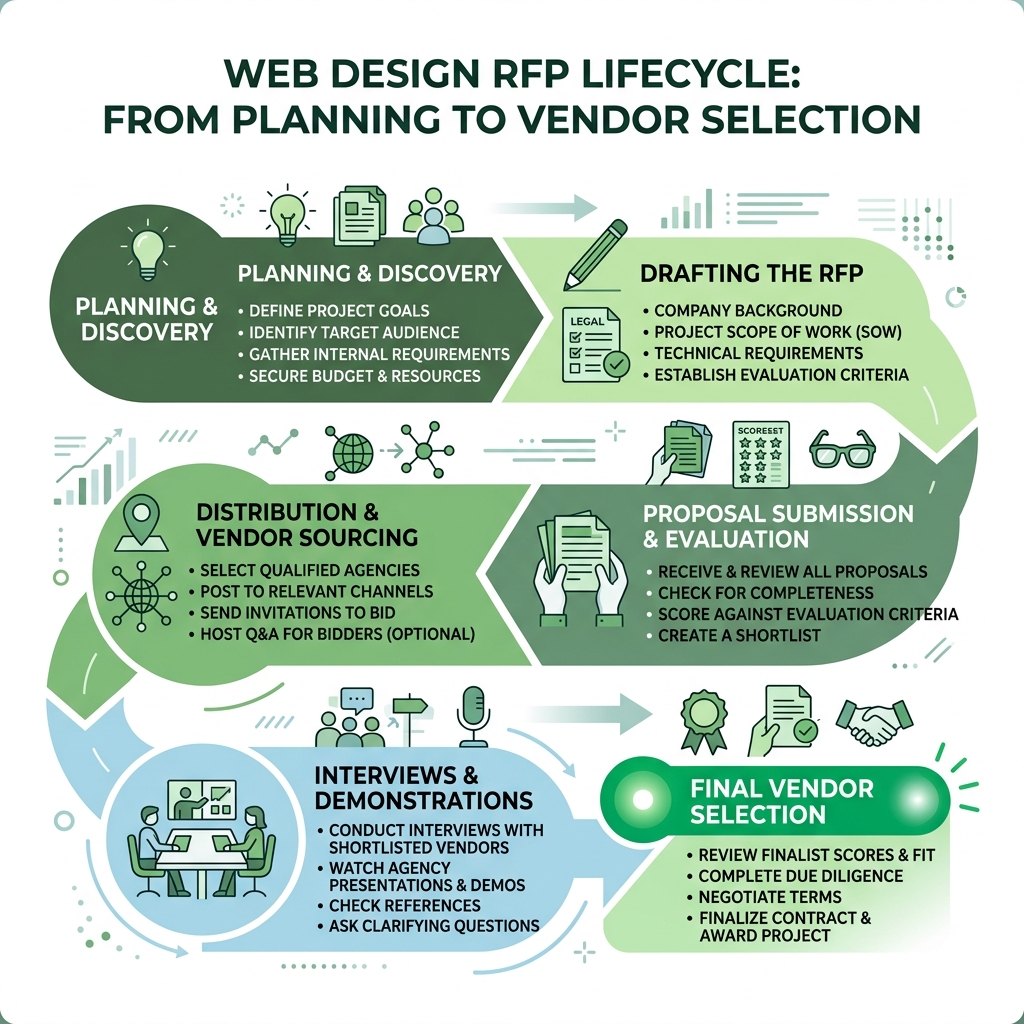
What is a Web Design RFP and Why is it Essential?
At its core, a web design request for proposal acts as a project blueprint. It is the foundation upon which your entire digital transformation is built. We often see businesses dive straight into calling agencies without a plan, but this usually leads to “apples-to-oranges” comparisons that leave stakeholders frustrated.
The RFP process is essential for vendor vetting. It forces us to sit down and articulate exactly what we need, which in turn allows agencies to provide accurate, fixed-fee estimates rather than vague hourly ranges. By standardizing the information every bidder receives, we create a level playing field. This transparency is vital for procurement departments, especially in larger organizations or government entities.
Furthermore, a strong RFP is a major tool for risk reduction. It addresses potential “gotchas” like ownership of code, post-launch support, and SEO requirements before a single line of code is written. If you don’t specify that you need a site that ranks well on Google, you might end up with a beautiful site that nobody can find.
When we talk about attracting qualified bidders, the RFP is our best foot forward. High-quality agencies are often selective about the projects they take on. A professional, detailed RFP signals that we are a serious client who has done the homework. Before you send yours out, consider these six crucial questions to ask when engaging a website designer to ensure you’re looking for the right partnership qualities.

When to Issue a Web Design Request for Proposal
Timing is everything. You don’t want to issue an RFP too early when your goals are still fuzzy, but waiting too long can lead to a rushed “panic build” that misses the mark. So, how do we know when it’s time?
We look at specific redesign triggers. If your business has undergone a significant brand evolution, your current site likely feels like a suit that no longer fits. Beyond aesthetics, the data often tells the story. Industry research indicates that:
- 81% of web designers believe a redesign is necessary if you have low conversion rates.
- 65% of designers point to high bounce rates as a sign the site is failing.
- 61% of designers say a redesign is the only way to fix fundamental user experience (UX) issues.
If your site is more than three to four years old, it’s likely falling behind in mobile responsiveness or security standards. Complex requirements—such as needing to integrate a new CRM, launching a massive e-commerce store, or complying with new accessibility laws—are also major indicators that a formal RFP is required.
Preparing for this stage involves internal alignment. We recommend checking out these 10 ways to prepare for working with a web design agency to get your internal stakeholders on the same page before the document goes live.
The Essential Structure of an Effective RFP
A great RFP doesn’t have to be a hundred pages long. In fact, some of the best ones we’ve seen are concise, hitting the high points in about 4 to 10 pages. The goal is to be thorough but readable.
The structure should follow a logical flow:
- Company Background: Don’t just give us your name. Tell us your mission, your values, and your “why.” This helps an agency understand the soul of the brand they are designing for.
- SMART Goals: Avoid vague statements like “we want a better site.” Instead, use Specific, Measurable, Achievable, Relevant, and Time-bound goals. For example: “Increase lead form submissions by 25% within six months of launch.”
- Target Audience: Who are we talking to? We need to know demographics, pain points, and what a “win” looks like for them.
- Design and Branding: If you already have a Design system or an established Logo design and branding guide, include it. If you need these created from scratch, make that a primary deliverable.
- Sitemap and Information Architecture: Even a rough outline of the pages you think you need helps us understand the scale of the project.
For a deeper dive into the “how-to” of the writing process, read our guide on crafting the ideal web design request for proposal.
Technical Requirements and CMS Considerations
This is where things get “geeky,” but it’s arguably the most important section for the developers. Your choice of a Content Management System (CMS) will dictate your team’s daily workflow for years to come. Whether you prefer the flexibility of WordPress, the robustness of Drupal, or the specialized tools of E-commerce technologies like Shopify or Magento, you must state your preference—or ask the agency to recommend one based on your needs.
We also need to define performance benchmarks. We suggest requiring a minimum score on PageSpeed Insights. A score of 80 or higher is a good baseline for performance, while 100 should be the goal for accessibility.
Other technical must-haves include:
- Mobile Responsiveness: It’s 2026; this isn’t optional, but specific device testing (like ensuring it works on older tablets) should be noted.
- ADA Compliance: To avoid legal risks, specify the level of WCAG compliance required.
- Security Standards: Mention if you need SSL, specific hosting environments, or compliance with regulations like GDPR or PCI DSS for e-commerce.
Defining Budget, Timeline, and Scope of Work
Budget transparency is a controversial topic, but we’ll be honest: withholding your budget range is usually a mistake. If you have $10,000 and the agency’s minimum is $50,000, you’ve both wasted hours of time. Providing a range allows the agency to propose the best possible solution within your means.
Timeline expectations also need to be grounded in reality. We’ve seen thousands of projects, and the timelines generally fall into these categories:
| Project Complexity | Estimated Timeline |
|---|---|
| Simple/Basic Site | 8 – 12 weeks |
| Mid-range Business Site | 4 – 6 months |
| Complex Web App / Large E-commerce | 9 – 12+ months |
When defining the scope, be clear about deliverables. Do you need copywriting? Professional photography? Custom illustrations? If you’re unsure if you need a full agency or just a solo pro, our comparison on should I hire a web design agency or a freelancer can help clarify your path.
Best Practices for Evaluating and Selecting Vendors
Once the proposals start rolling in, the real work begins. We recommend forming a small selection committee of 3 to 5 key stakeholders from different departments (e.g., Marketing, IT, and Sales).
Use a weighted scoring system to evaluate each proposal fairly. You might assign points based on:
- Relevant Experience (30%): Have they built sites for your industry or with your specific technical needs?
- Project Approach (25%): Does their process seem logical and collaborative?
- Portfolio Quality (20%): Is their work modern, functional, and diverse?
- Cost (15%): Does it fit your budget without being “suspiciously cheap”?
- References (10%): What do their past clients say when you call them?
Don’t forget the “vibe check.” You’ll be working with this team for months, so culture fit matters. To help you narrow down the field, keep these six things to look for in a good web designer in mind during the interview phase.
Real-World Examples of a Successful Web Design Request for Proposal
Looking at what others have done can provide immense clarity. Some of the most robust examples available online come from large organizations that prioritize transparency.
For instance, the Website redesign RFP example – W3C is a gold standard for technical and accessibility requirements. Similarly, the Example RFP for Website discovery, design and development – The Rockefeller Foundation shows how to structure a project that involves deep discovery and strategy phases before the design even starts.
If you are working within a charitable or civic context, it is worth noting that the process can differ slightly. We’ve outlined the pros and cons of an RFP for non-profit organizations to help those teams navigate their unique board-approval processes and budget constraints.
Frequently Asked Questions about Web Design RFPs
Where can I find a free web design request for proposal template?
There are many great resources online, but we recommend starting with a template that has been vetted by actual government or educational institutions, as they are often the most thorough. A great starting point is the Website redesign RFP template – Franklin County, North Carolina. It provides a clean, Word-document structure that you can easily adapt to your business needs.
How do you handle vendor questions and follow-up?
We suggest setting a specific “Q&A period” in your RFP timeline. Allow vendors to submit questions via email by a certain date. To keep the process fair, compile all questions and your answers into a single document and send it to all participating agencies at once. This ensures no one has an “inside track” and everyone is bidding on the same information.
What common mistakes should be avoided when writing an RFP?
The biggest mistake is being too vague. If you don’t define your “must-haves” versus your “nice-to-haves,” you’ll get proposals that miss the mark. Another pitfall is setting an impossible timeline. If you ask for a complex e-commerce site to be built in four weeks, the best agencies will simply decline to bid because they know it’s not possible to do it well. Finally, don’t ignore the post-launch phase. Always ask about hosting, maintenance, and how they handle SEO after the site goes live.
Conclusion
At BYTE DiGTL, we believe that a website is more than just a digital brochure—it’s your hardest-working employee. Whether you are in Littleton, Denver, Monterey, New York, Minneapolis, or looking for a Byte Digital Web Design Agency Dallas, we know that the success of your project starts with the clarity of your vision.
Writing a web design request for proposal might seem like a daunting task, but it is an investment that pays dividends in the form of a smoother project, a better relationship with your agency, and ultimately, a website that drives real business growth. By following the steps in this guide—defining your goals, being honest about your budget, and setting clear technical standards—you are setting yourself up for a win.
If you’re ready to start your next project but need an expert partner to help refine your requirements, we’re here to help. Our specialist teams provide multi-channel strategies and high-end development at a fraction of the cost of a full-time in-house team. Let’s build something great together.