
What Are Branding Deliverables? (And Why Most Companies Get Shortchanged)
Branding deliverables are the tangible assets and documents you take home after working with a creative agency. They are the actual files, guides, and materials you use to run your business, not the process of creating them.
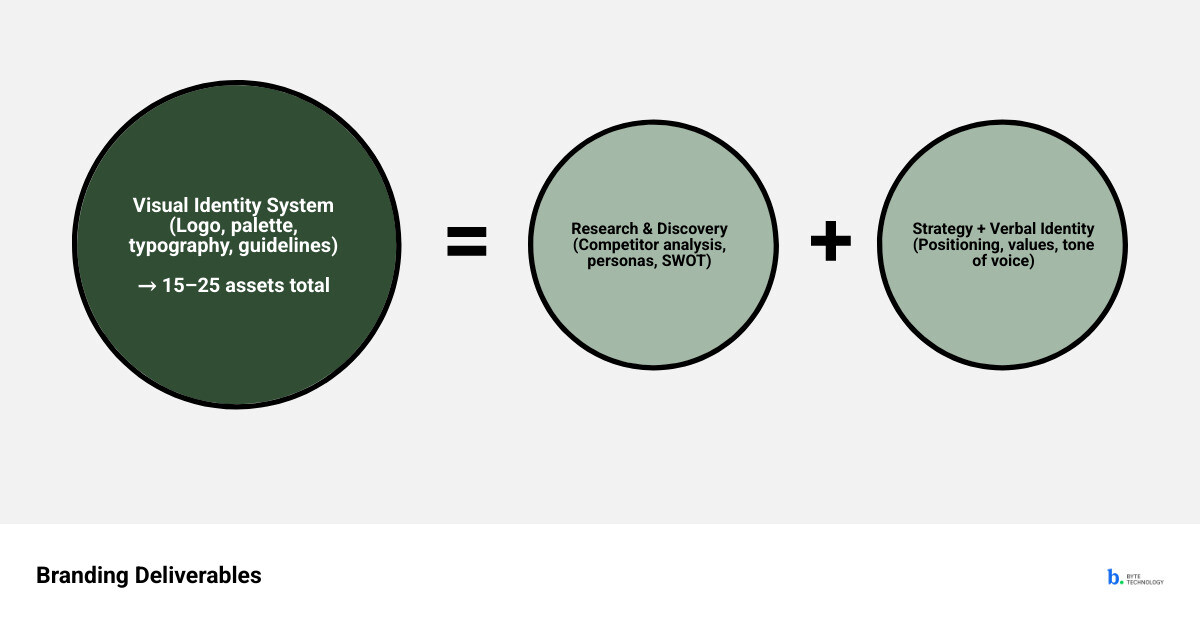
Here is a quick breakdown of what a complete branding project delivers:
| Layer | What You Get |
|---|---|
| Research and Discovery | Competitor analysis, audience personas, SWOT analysis |
| Brand Strategy | Positioning statement, brand values, mission, touchpoints |
| Verbal Identity | Messaging framework, tone of voice guide, brand name |
| Visual Identity | Logo system, color palette, typography, graphic elements, brand guidelines |
A complete engagement typically produces 15 to 25 distinct assets across these four layers.
Most businesses only receive the visual layer, which is logos and colors. The research, strategy, and verbal identity layers get skipped entirely. That is a big reason why most rebrands fail within 18 months.
As Byte DiGTL’s web development and digital systems team, we have spent over a decade building brand-aligned digital platforms and design systems for businesses at every stage. That hands-on experience with branding deliverables across industries is what shapes this guide.
Demystifying the Brand Package: What Are Branding Deliverables?
When businesses set out to hire a creative agency, they often find themselves drowning in design jargon. You hear terms like “brand equity,” “holistic positioning,” and “visual ecosystems.” But when the invoice is paid, what are you actually taking home?
To put it simply, branding deliverables are the concrete assets you own at the end of a project. They are the files you upload to your website, the guidelines you hand to your internal marketing team, and the templates you use to pitch new clients.
Many agencies intentionally blur the lines between their creative process and the final assets to justify high pricing. They sell you on a massive, all-inclusive package when you might only need specific, high-value assets. To avoid getting locked into expensive and unnecessary agency upselling, you must understand exactly what is included in your project scope.
Before signing any contract, you need to know what assets will live in your final delivery folder. If you want to understand the full scope of what a professional engagement includes, read our guide on What Does Branding Include? Full Deliverables Breakdown 2026.
The Core Difference: Branding Services vs. Branding Deliverables
One of the most common points of confusion for business owners is the difference between a branding service and a branding deliverable.
- Branding Services represent the strategic process, creative labor, and collaborative hours an agency spends developing your brand. This includes running discovery workshops, conducting market research, designing logo concepts, and hosting feedback sessions. You are paying for the agency’s expertise, time, and creative direction.
- Branding Deliverables are the tangible, final outputs resulting from those services. They are the physical and digital assets delivered during the client handoff.
For example, a “Deep Dive workshop” is a service. The “Audience Persona PDF” or “SWOT Analysis Document” resulting from that workshop is the deliverable. You cannot upload a workshop to your website, but you can use an audience persona document to guide your entire digital marketing strategy.
To ensure your team can actually use these assets without constantly paying an agency for file conversions or minor updates, you need a highly organized delivery package. You can review a complete checklist of what a professional handoff package should look like in this Brand Identity Deliverables List for Client Handoff.
Strategic Foundations: Brand Strategy vs. Brand Identity Deliverables
Another critical distinction is the difference between brand strategy deliverables and brand identity deliverables.
Brand strategy deliverables define the core DNA of your business. They answer the “why” and “who” behind your company. These are internal facing documents, such as your brand positioning statements, target audience profiles, and core values. While these assets are invisible to your customers, they form the foundation for every business decision you make.
Brand identity deliverables, on the other hand, are the external facing visual and verbal components. They translate your strategy into things your audience can see and hear, such as your logo system, typography, color palettes, and copywriting guidelines.
Without a strong strategic foundation, your visual identity is just a collection of pretty pictures. True brand equity is built when your strategy and identity work together to create a cohesive, recognizable customer experience. If you are ready to build a brand that stands out, explore our insights on Building A Strong Business Identity Going Beyond The Logo.
The Four Layers of a Complete Brand System
A durable brand is not a single logo file. It is a complete asset ecosystem built on a logical brand architecture. To ensure your brand remains consistent across search, social media, print, and digital platforms, your agency should deliver assets across four distinct layers.
Layer 1: Research and Discovery
The research phase is the foundation of your entire brand system. While some businesses try to skip this layer to save money, doing so is highly risky. Decisions made without research are based on pure guesswork. A professional research layer includes:
- Audience Research: Deep insights built from 8 to 15 real customer interviews, defining demographic data, psychographic motivations, and behavioral archetypes.
- Competitor Research: An in-depth analysis of your direct and indirect competitors, mapping out their visual styles, messaging, and market positioning.
- Marketplace Trends: A study of where your industry is heading, ensuring your brand looks modern and remains relevant for years to come.
- SWOT Analysis: A clear breakdown of your brand’s strengths, weaknesses, opportunities, and threats.
Layer 2: Brand Strategy
Once the research is complete, the agency translates those insights into a clear strategic roadmap. The key deliverables in this layer include:
- Brand Positioning Statement: A concise statement that explains who you serve, what you do, and how you do it better than anyone else.
- Brand Values: A set of core principles that guide your business. The best agencies frame these values as actionable verbs rather than passive adjectives, making them easier for your employees to live by.
- Mission and Vision Statements: Clear declarations of your company’s immediate goals and long-term aspirations.
- Brand Touchpoints Map: A breakdown of every physical and digital location where customers interact with your brand, ensuring a seamless experience across all channels.
Layer 3: Verbal Identity
Your verbal identity is how your brand speaks to the world. It bridges the gap between your abstract strategy and your visual design, ensuring your messaging is just as memorable as your logo. Key verbal deliverables include:
- Messaging Framework: A structured guide containing your value propositions, key selling points, and audience-specific elevator pitches.
- Tone of Voice Guidelines: Rules that define your brand’s personality, complete with practical “do and don’t” writing examples and before-and-after copy transformations.
- Brand Naming: If you are launching a new business, this includes a curated list of vetted, trademark-safe names.
- Core Copywriting: High-stakes copy for your website, pitch decks, and brand launch materials. If you need professional, strategic copy to bring your brand to life, check out our Content Creator services.
Layer 4: Visual Identity
This is the most famous layer of branding, containing the visual assets that make your business instantly recognizable. A complete visual identity package includes:
- Logo System: A versatile set of marks including your primary logo, secondary logo, submarks, and simplified favicon versions.
- Color Palette: A curated color system with exact color codes for both print (CMYK, Pantone) and digital (RGB, HEX) applications.
- Typography System: Your primary and secondary brand fonts, complete with clear hierarchy rules and web-safe fallback options.
- Graphic Elements and Patterns: Custom icons, brand patterns, and illustrative elements that support your visuals when the logo is not present.
To see how these elements combine into a single, cohesive package, you can review our Brand Identity Package Checklist for 2026.
Logo Package vs. Full Brand System: What Are You Actually Paying For?
The primary reason most rebrands fail within 18 months is that businesses pay for a “branding package” but only receive a logo package. A logo is a vital tool for recognition, but a full brand system is what drives repetition, consistency, and long-term brand equity.
| Feature | Logo Package | Full Brand System |
|---|---|---|
| What is included | 1-2 logo marks, a basic color palette, and a font list. | 15-25 assets across research, strategy, voice, and design. |
| Primary focus | Basic visual recognition. | Complete operational consistency across all business channels. |
| Strategic foundation | None. Based on aesthetic preferences. | Built on competitor research and customer interviews. |
| Scalability | Low. Hard to apply to new marketing channels. | High. Includes design systems and templates for rapid growth. |
| Post-project support | Minimal. You receive raw files and are on your own. | High. Includes clear guidelines, templates, and training. |
If you are paying tens of thousands of dollars and only receiving a logo and a basic brand sheet, you are being shortchanged. A true brand system provides your business with the operational tools needed to scale.
Budget Breakdown Across the Four Layers
How much should you invest in each layer of your brand? While every project is unique, a healthy resource allocation ensures you do not overspend on visuals while ignoring strategy.
- Research & Discovery (15% to 20% of budget): Funding customer interviews, market audits, and competitive positioning maps.
- Brand Strategy (20% to 25% of budget): Developing your core positioning, values, and brand architecture.
- Verbal Identity (15% to 20% of budget): Crafting your messaging framework, tone of voice, and core website copy.
- Visual Identity & Design (40% to 50% of budget): Designing the logo system, typography, color palettes, templates, and final brand guidelines.
Investing in a complete four-layer system ensures your brand remains highly effective for five to ten years, rather than needing another expensive redesign in a year. If you want to explore the financial and operational benefits of updating your business’s identity, read our guide on New Year New Branding The Benefits Of Rebranding Your Business.
Brand Book vs. Brand Guidelines vs. Design System
As your brand assets are delivered, you will likely receive several instructional documents. While these terms are often used interchangeably, they serve very different purposes:
- Brand Book: A highly visual, inspiring document (usually under 30 pages) that tells your brand story, mission, and values. It is designed to get your internal team, partners, and investors excited about the brand’s vision.
- Brand Guidelines (Style Guide): A practical, technical manual that outlines the rules of your visual and verbal identity. It shows exactly how to use your logos, colors, typography, and messaging, complete with clear “correct vs. incorrect” usage examples.
- Design System: A highly technical, interactive library (often built in Figma) designed for digital-first brands. It contains reusable components, buttons, forms, and layout grids that allow web designers and developers to build new digital touchpoints with pixel-perfect consistency.
Technical Handoff: File Formats, Organization, and Governance
A brand identity project is only as good as its final handoff. A messy, unorganized Google Drive folder with poorly named files will lead to immediate confusion, asset misuse, and endless support emails. A professional agency treats the handoff as a moment of celebration, organizing files by client use cases rather than confusing file extensions.
To learn how to execute a flawless, professional handoff that protects your creative work, read this guide on How to Deliver a Brand Identity Package to a Client | TrunkTransfer Blog.
Visual Identity File Formats
When your visual identity is delivered, you should receive your assets in both vector and raster formats, optimized for different use cases.
- Vector Formats (SVG, EPS, AI): These are mathematical, infinitely scalable files. They can be sized up to the size of a billboard or down to a tiny website icon without losing any quality. SVG is the gold standard for digital use, while EPS and AI are the industry standards for professional print vendors.
- Raster Formats (PNG, JPG): These are pixel-based files. PNG files support transparent backgrounds, making them perfect for website headers and slide decks. JPG files are ideal for high-resolution photography and simple digital displays.
- ASE Files (Adobe Swatch Exchange): A highly useful deliverable that allows your design team to upload your exact brand colors into Adobe tools in a single click, eliminating manual color entry errors.
Handoff Hygiene and Long-Term Governance
To keep your brand assets secure and easy to find, look for agencies that practice excellent handoff hygiene:
- The README Folder: A dedicated folder named
00_READMEcontaining a short, 2 to 4 page brand usage guide. This folder is sorted to the top of your directory and explains exactly how to navigate your files. - Font Licensing: A clear document listing the exact names of your brand fonts, their license types, and links to purchase them. Professional agencies never redistribute unlicensed font files.
- Usage Rights: A legal agreement detailing who owns the final design files and whether source files are included in your project scope.
To prevent scope creep and establish clear milestones for file delivery, review this guide on Brand identity proposal: milestones for concepts, revisions, and final files | Lervos Blog.
Frequently Asked Questions About Branding Deliverables
Managing a branding project can raise a lot of questions. Here are some of the most common concerns we hear from clients during the delivery phase.
How do I audit my existing brand to identify gaps in my deliverables?
To find out if your brand assets are actually serving your business, you can perform a quick, structured brand audit:
- Gather Your Assets: Collect your website link, social media profiles, pitch decks, proposals, and marketing materials.
- Analyze Consistency: Place these assets side-by-side. Do they look like they come from the same company? Is the logo placed correctly? Are the colors and fonts consistent?
- Assess Strategy and Messaging: Ask five different employees to describe what your company does in a single sentence. If their answers do not align, your verbal identity and strategy layers are missing.
- Create a Scorecard: Build a simple three-column sheet listing your assets as “Included,” “Missing,” or “Needs Update.” This will show you exactly where your brand deliverables are falling short.
Which branding deliverables are non-negotiable for a new business versus an established business?
Your business stage and budget should dictate the depth of your branding deliverables, not the scope of the layers covered.
- New Businesses (Startups): You need a lean, “minimum viable brand.” Your focus should be on a clean starter identity: a primary logo, a secondary logo, a simple color palette, a typography system, and a basic 10-page style guide. This gives you a professional look without a massive initial investment.
- Established Businesses: As your business grows and scales, your brand needs to evolve. You require a complete brand system, including in-depth customer research, advanced verbal messaging, custom e-commerce assets, and interactive design systems.
To keep your brand assets fresh, modern, and aligned with your marketing channels, explore our Monthly Marketing Services.
What are the most commonly overlooked or skipped branding deliverables by agencies?
When reviewing an agency’s proposal, watch out for these commonly skipped assets:
- Social Media Templates: Easy-to-use, editable templates (in Canva or Figma) for Instagram, LinkedIn, and Facebook posts.
- Favicons: A tiny, simplified 512x512px version of your logo designed specifically for web browser tabs.
- Email Signatures: Clean, professional, HTML-compliant email signature templates for your team.
- Video Tutorials: A quick, recorded screen-share walkthrough explaining how to use your new file system and edit your brand templates.
Conclusion
At BYTL DiGTL, we believe that your brand is the operating system of your business. A beautiful logo is a great start, but to scale your business, you need a highly consistent, professional brand system that works seamlessly across every marketing channel.
Through our affordable Byte Bundles, we provide businesses with specialist teams to manage your web development, e-commerce platforms, and multi-channel marketing strategies, all at a fraction of the cost of a single full-time employee.
If you are ready to take control of your brand and set your business up for long-term growth, here are your next steps:
- Run a Brand Audit: Use our scorecard method to find the gaps in your current brand assets.
- Define Your Scope: Use our checklist to outline the exact deliverables you need before reaching out to an agency.
- Partner with Experts: Let us help you translate your brand into a high-converting digital experience.
To start building a brand strategy that drives real business results, explore our Marketing Branding Strategy services today.

