
What Does a Website Domain Actually Cost in 2026?
Understanding the cost of website domain registration is one of the first things you need to nail down before building your online presence. Here is a quick snapshot of what you can expect to pay:
| Domain Type | Typical Annual Cost |
|---|---|
| Standard .com | $10 to $20 |
| Standard .net / .org | $10 to $22 |
| Country-code TLD (e.g., .us, .co.uk) | $8 to $20 |
| Niche/tech TLD (e.g., .io, .ai) | $40 to $130 |
| Premium or aftermarket domain | $100 to $1,000,000+ |
These are registration costs. Renewal rates are often higher than the first-year price, and hidden fees can catch you off guard.
A few things worth knowing upfront:
- Domain names are rented, not owned. You pay annually to keep them.
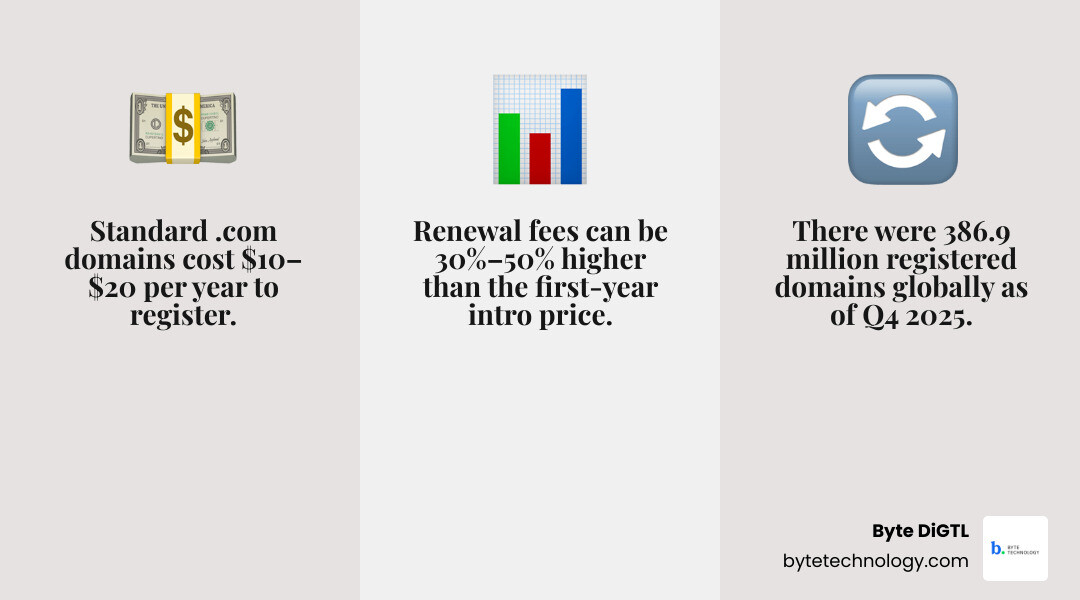
- Most standard domains cost $10 to $20 per year to register.
- Renewal fees at some registrars run 30% to 50% higher than the intro price.
- Add-ons like WHOIS privacy protection, domain security, and email hosting can push your total cost up.
As of Q4 2025, there were 386.9 million registered domains globally, and that number is still growing. Competition for short, memorable names is real, and pricing reflects it.
At Byte DiGTL, we have helped businesses of all sizes navigate the full cost of website domain registration, hosting, and digital setup, so this guide is built from real-world experience. This article breaks down every cost factor so you can make a smart, budget-conscious decision.
What is the Average Cost of Website Domain Registration?
When you set out to buy a standard domain name, you will generally find that the average cost of website domain registration runs between $10 and $20 per year. This price grants you the exclusive right to use that specific address on the internet for a period of twelve months.
However, the domain market is highly dynamic. The total number of domain name registrations across all top-level domains reached 386.9 million by the end of the fourth quarter of 2025. This was up 8.4 million, or about 2.2%, from the previous quarter, and represented a 22.7 million, or 6.2%, increase year-over-year. As more businesses and creators claim their digital space, the inventory of short, intuitive names shrinks, which naturally drives up the value of remaining options.
Another major driver of domain pricing is the wholesale cost set by the registries that manage individual extensions. For example, Verisign, the company that exclusively operates the .com top-level domain, has increased wholesale prices by 30% since 2018. Under its regulatory agreements, Verisign is permitted to increase wholesale prices by up to 7% in four out of every six years of its contract cycle.
According to the latest Verisign .com wholesale price updates, the wholesale price of a .com domain is scheduled to increase from $10.26 to $10.97 on November 1, 2026. This is a predictable 6.9% increase that registrars will almost certainly pass on to consumers in the form of higher retail registration and renewal fees. If Verisign continues to implement these maximum allowed increases, the wholesale price of a .com domain could reach approximately $13.42 by the end of the current contract cycle.
With these rising costs, choosing the right digital asset becomes a long-term financial commitment. If you are launching a new brand or expanding an existing business, it is worth carefully deciding whether to purchase a new domain or stick with what you currently have. Registering a completely new name can give you a fresh start, but you must factor in these compounding annual renewal costs from day one.
Key Factors That Influence Domain Name Pricing
The price tag on a domain name is rarely arbitrary. It is shaped by a mix of market demand, registration length, extension type, and registrar markups. Understanding these variables can help you spot a fair deal and avoid overpaying.
One of the most immediate factors is the length and simplicity of the domain. The average domain length across the web is 13 characters. However, when you look at the world’s 500 most popular websites, the average domain length drops to just seven characters. Short, punchy domains are incredibly easy for users to remember and type, which makes them highly valuable. If you want a domain that is under eight characters and uses common dictionary words, you will likely have to pay a premium.
Keyword demand also plays a massive role. If your domain contains high-value search terms, such as insurance, credit, or attorney, it will command a much higher price because of its potential to capture organic search traffic. Additionally, registrars apply their own markups to wholesale prices to cover customer support, security infrastructure, and profit margins.
Finally, regional differences and local taxes can influence the final checkout price. Depending on whether you are purchasing your domain from an office in Denver CO, New York NY, or Dallas TX, local sales taxes and currency conversion rates may be added to the base cost.
How TLD Extensions Affect the Cost of Website Domain Names
The Top-Level Domain, or TLD, is the suffix at the end of your website address, such as .com, .org, or .net. The choice of TLD is the single biggest factor in determining your ongoing domain costs.
Traditional generic TLDs, known as gTLDs, remain the most popular and trusted options on the web. The .com extension is the undisputed king, boasting over 157 million registrations globally. Because of this massive popularity, a standard .com domain generally costs between $10 and $20 per year to register. Other traditional extensions are also highly popular, with the .de country-code extension for Germany holding approximately 17.6 million registrations, followed by .net with 12.6 million and .org with 11.1 million.
If you are looking for a complete breakdown of how these extensions stack up financially, you can consult this comprehensive guide to domain costs. It details how newer extensions, such as .shop, .app, and .blog, can sometimes be registered for as little as $2 in the first year, but often renew at much higher rates, ranging from $30 to $60 per year.
Meanwhile, specialized tech extensions have skyrocketed in popularity. The .ai extension, which technically belongs to the island of Anguilla but has been co-opted by the artificial intelligence industry, now costs significantly more than standard options. A .ai domain often starts at $70 to $100 per year, and some registrars require a minimum two-year registration commitment, pushing your initial checkout cost to $140 or more. Similarly, the .io extension, popular among startups, typically ranges from $40 to $70 per year.
When planning your branding, choosing the best words for your domain is just as important as choosing the right TLD. Opting for a creative combination of words under a standard .com extension is often far more budget-friendly than choosing a highly sought-after single word under a trendy, expensive TLD.
Premium and Aftermarket Domain Valuations
If the domain name you want is already owned by someone else, you enter premium and aftermarket domains. Premium domains are short, highly memorable, and contain high-demand keywords. They are valued for their immediate brand authority and SEO advantages.
These domains can cost anywhere from a three-figure sum to a seven-figure sum. We generally divide these into two categories:
- Registry Premiums: These are domains that the registry itself identifies as high-value and prices higher from the very beginning. They typically cost between $100 and $5,000 per year, and unlike aftermarket domains, they often renew at that same high premium rate every year.
- Aftermarket Domains: These are domains that have already been registered by private individuals or investors and are offered for sale on secondary marketplaces. They typically cost between $1,000 and $1,000,000+ as a one-time purchase fee, after which they renew at the standard annual rate for that TLD.
To give you an idea of how high these valuations can go, LasVegas.com was purchased for a reported $90 million in 2005, and cars.com sold for a staggering $872 million. While the average local business in Minneapolis MN or Monterey CA does not need to spend millions, investing a few thousand dollars in a clean, memorable aftermarket domain can sometimes save you tens of thousands of dollars in future marketing and advertising costs.
Registrar Pricing Models and Promotional Rates
Registrars use a wide variety of pricing models to attract buyers, and it is easy to fall into a trap if you only look at the initial checkout price. Many registrars offer deep introductory discounts, selling a .com domain for $0.99 or $1.99 for the first year. However, the renewal price in the second year can jump to $18.00, $22.00, or even $30.00.
For example, a standard .com domain costs $9.90 for the first year with Wix, but subsequent renewals return to standard retail rates. GoDaddy’s standard .com renewal pricing sits at $22.99 per year, which is significantly higher than its initial promotional rates.
To combat these retail markups, some providers have introduced membership-based models. These programs allow you to bypass traditional retail markups entirely. By reviewing these at-cost domain pricing models, you can see how membership programs charge a flat annual fee in exchange for letting you register and renew domains at the exact wholesale price charged by the registry, which is often around $9.50 to $10.00 for a .com domain.
Alternatively, at-cost registrars like Cloudflare pass registry prices directly to the consumer with zero retail markup, though they do not offer promotional first-year discounts.
Hidden Fees and Ongoing Domain Ownership Costs
The initial purchase price of a domain is rarely the only expense you will encounter. To keep your domain secure, private, and functional, you must navigate several hidden fees and ongoing costs.

One of the most common add-ons is WHOIS privacy protection. When you register a domain, ICANN, the non-profit organization that coordinates the domain name system, requires your personal contact information, including your name, email, phone number, and physical address, to be published in a public database.
To prevent spammers and telemarketers from scraping this data, registrars offer privacy protection, which replaces your personal details with proxy information. While some registrars include WHOIS privacy protection for free, others charge an additional $10 to $15 per year for this service.
You must also account for the mandatory ICANN fee. This is a flat $0.18 to $0.20 annual fee applied to almost every domain registration, renewal, or transfer globally. While some registrars bundle this fee into their advertised price, others tack it on at checkout as a surprise charge.
Additionally, if you ever decide to move your domain to a different provider, you will face transfer fees. While the transfer itself is sometimes free, most registrars require you to pay for an additional one-year renewal at the time of transfer, which typically costs $10 to $20.
Finally, if you miss your renewal deadline, your domain will eventually enter a redemption period. Recovering a domain from this state requires paying steep redemption and recovery fees, which typically range from $80 to $150+, far exceeding the standard renewal rate.
Managing the Long-Term Cost of Website Domain Renewals
To protect your digital brand and keep your domain secure over the long haul, you must actively manage your renewal timelines. Letting a high-value domain expire can be a costly mistake, both in terms of recovery fees and lost business.
Certain country-code TLDs, such as .ch (Switzerland) or .fr (France), have highly strict auto-renewal requirements. If you do not renew or set these domains to auto-renew at least 5 to 12 days before their official expiration date, they can immediately slip into a redemption period, forcing you to pay a high fee to get them back.
To hedge against rising prices, you can lock in multi-year registrations. Under ICANN regulations, the maximum period a domain name can be registered for at one time is ten years. If you know you are committed to your brand for the long term, registering or renewing your domain for the maximum ten-year limit protects you from any annual wholesale price hikes implemented by registries during that decade.
If you manage your domains through cloud infrastructure, you must also keep an eye on platform-specific updates. For instance, according to the official cloud platform domain registration pricing schedule for Amazon Route 53, standard .com registration and renewal costs are set to increase from $15.00 to $16.00 per year starting July 1, 2026.
On the same date, the price of a .ai domain on Route 53 will rise from $129.00 to $137.00 per year, and specialized extensions like .movie will jump from $329.00 to $386.00 per year. Reviewing these schedules ahead of time allows you to renew your domains early and lock in the lower rates.
Domain Registration vs. Website Hosting Costs
A common point of confusion for new website owners is the difference between domain registration and website hosting. While they are often sold together, they are two completely distinct services that serve entirely different purposes.
To put it simply, your domain name is your digital address. It is the map coordinate that tells people how to find you on the map. Website hosting, on the other hand, is the physical plot of land and the building where your website’s files, images, code, and databases actually live. You cannot have a functioning website without both.
| Feature | Domain Registration | Website Hosting |
|---|---|---|
| What it is | Your website’s address (e.g., yourbusiness.com) | The server space where your website files are stored |
| Typical Cost | $10 to $20 per year | $5 to $100+ per month |
| How it works | Points users to your hosting server’s IP address | Serves your website files to visitors when they type your domain |
| Payment Cycle | Billed annually | Billed monthly or annually |
Many providers offer convenience by bundling your domain and hosting package together. This is often an excellent way to simplify your billing and get your site online quickly. Many hosts will even throw in a free domain registration for the first year when you sign up for an annual hosting plan.
However, you must be careful with cheap, generic hosting packages. While they look attractive on paper, they often come with hidden performance bottlenecks, poor security, and slow loading speeds.
By understanding the hidden costs of cheap website hosting, you can see why investing in high-quality, professional hosting is crucial. Slow hosting can hurt your SEO rankings, frustrate your visitors, and ultimately cost you far more in lost e-commerce sales than you save on the monthly hosting bill.
Whether you are looking for a comprehensive A-Z Guide to Website Hosting Services or trying to find the 10 Best Website Hosting Colorado Providers near our Littleton CO and Denver CO offices, choosing a host that offers local support, robust security, and rapid speeds is essential.
If you want to dive deeper into the technical details, you can read up on the high altitude guide to choosing a Denver web host or explore tips on how to host your personal website and keep your wallet happy without sacrificing quality.
Understanding the need for speed: the overwhelming benefits of a fast website hosting setup will help you see why domain registration is only the first step. To bust some common industry rumors, you can also check out just the facts: web hosting truths and myths to ensure you are making decisions based on data rather than marketing hype.
Frequently Asked Questions About Domain Pricing
Can I get a free domain name permanently?
No, you cannot get a domain name for free permanently. While many website builders and hosting providers offer a free domain name for the first year as a promotional signup bonus, you will always be responsible for paying the standard annual renewal fee in subsequent years to maintain ownership.
Any service that claims to offer a completely free domain forever usually hosts your site on a subdomain, such as yourname.provider.com, which looks unprofessional and limits your brand’s growth and SEO potential.
What happens if my domain name expires?
When your domain name expires, it goes through a multi-stage expiration process:
- Grace Period: For the first 30 to 45 days after expiration, your website and email services will stop working, but you can still renew the domain at the standard renewal price.
- Redemption Period: If you do not renew during the grace period, the domain enters a redemption phase lasting about 30 days. To recover it now, you must pay the standard renewal fee plus a steep redemption fee, which typically ranges from $80 to $150+.
- Pending Delete: If left unpaid, the domain enters a 5-day deletion phase, after which it is released back to the public or sold at a public expired-domain auction to the highest bidder.
Why do some domain extensions cost thousands of dollars?
Certain domain extensions are priced exceptionally high because they are positioned as premium, industry-specific branding assets. For example, the .inc extension, which targets established corporations, can cost over $2,000 per year because registries know that corporate entities are willing to pay a premium for exclusive, highly professional branding.
Other extensions, such as .cars or .auto, are priced high to maintain exclusivity within their respective industries and prevent domain squatters from buying up valuable inventory.
Conclusion
Securing your domain is the foundation of your digital identity, but managing the ongoing cost of website domain registration, renewal fees, and hosting requires a clear, strategic approach. By choosing a memorable name, opting for a stable TLD, and keeping an eye out for hidden renewal hikes and redemption fees, you can build a secure online presence that fits your budget.
At Byte DiGTL, we specialize in helping businesses across our Littleton CO, Denver CO, Monterey CA, New York NY, Minneapolis MN, and Dallas TX locations navigate the entire digital landscape. From custom e-commerce development and high-speed website hosting to multi-channel digital marketing, we provide affordable Byte Bundles that give you access to specialist teams at a fraction of the cost of a full-time employee.
If you are ready to secure your digital address and build a high-performance website that drives real business growth, contact us at our website hosting company today to explore how we can help you succeed.