
Why API Development Services Are the Backbone of Modern Business Software
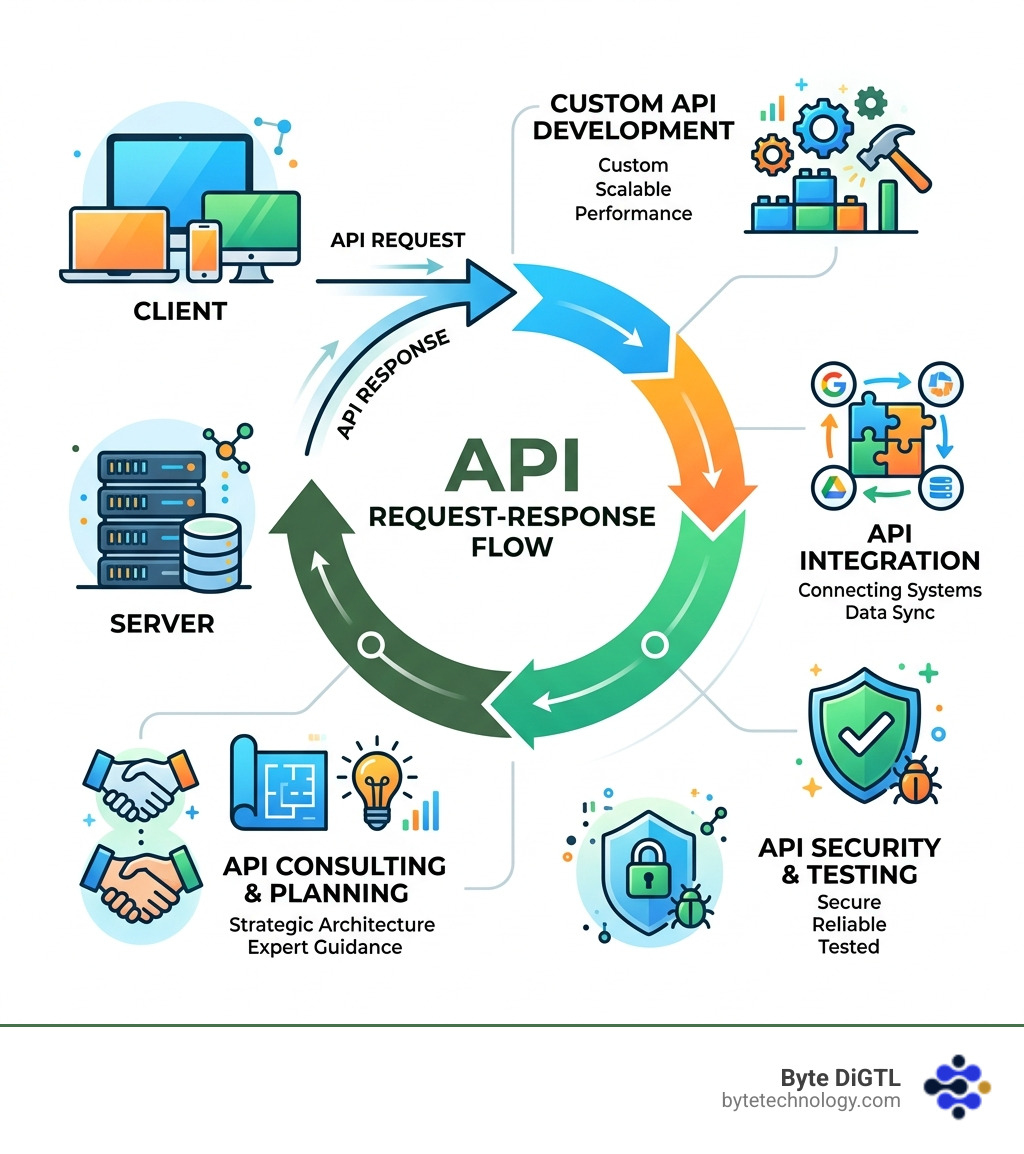
API development services are professional solutions for designing, building, testing, and maintaining the interfaces that allow software systems to talk to each other. Here’s a quick overview of what they include:
- Custom API development – Building APIs tailored to your specific business needs
- API integration – Connecting your systems to third-party tools like Stripe, Shopify, or Salesforce
- API consulting – Planning the right architecture and protocols for your goals
- API testing and security – Ensuring your APIs are reliable, fast, and protected
- API maintenance and documentation – Keeping your APIs up to date and easy to use
Today, the average app runs on anywhere between 26 and 50 APIs. Nearly 90% of developers use APIs in some form, and 74% have adopted an API-first approach as of 2024. The global API management market is on track to grow from $5.42 billion in 2024 to $32.77 billion by 2032.
In short: APIs aren’t a technical nicety anymore. They’re the connective tissue holding modern digital businesses together.
Whether you’re a small business owner trying to sync your inventory with your online store, or a growing company that needs to automate workflows between platforms, APIs make it possible without rebuilding everything from scratch.
I’m Matthew Purdom, Director of Web Development at Byte DiGTL, with over a decade of experience building scalable web systems and delivering api development services that help businesses connect their tools and grow without the overhead of a large technical team. In the sections below, I’ll walk you through everything you need to know to make smart decisions about APIs for your business.
Understanding the Core of Modern API Development Services
At its simplest, an API (Application Programming Interface) is a set of rules that allows one piece of software to request information or actions from another. Think of it like a waiter in a restaurant: you (the client) look at the menu and tell the waiter (the API) what you want. The waiter takes that request to the kitchen (the server), and then brings the food (the response) back to your table.

In web application development, this interaction follows a client-server architecture. The client is usually a web browser or a mobile app, and the server is where the data and business logic live.
To make this communication work, we use several key concepts:
- Endpoints: These are specific digital “addresses” (URLs) where the API can be reached. For example,
api.yourbusiness.com/v1/ordersmight be the endpoint to see a list of customer purchases. - HTTP Methods: These are the “verbs” of the API.
- GET: Retrieve data (like viewing a product page).
- POST: Send new data (like submitting a contact form).
- PUT: Update existing data (like changing a shipping address).
- DELETE: Remove data (like canceling a subscription).
- Data Formats: Most modern api development services use JSON (JavaScript Object Notation) because it is lightweight and easy for both humans and machines to read. Older systems might still use XML, which is more verbose but highly structured.
Key Components of API Development Services
Building a “working” API is one thing; building a professional one is another. When we develop APIs for our clients in Denver or Dallas, we focus on several critical components:
- Authentication & Authorization: Authentication proves who you are (e.g., using an API key), while authorization determines what you are allowed to do once you’re “in.”
- Rate Limiting & Throttling: To prevent a single user from crashing the server by sending too many requests at once, we set limits on how many calls can be made per minute or hour.
- Status Codes: These tell the client what happened. You’ve likely seen a “404 Not Found” error; APIs use dozens of these codes (like 200 for “OK” or 500 for “Server Error”) to communicate clearly.
- Headers & Payloads: Headers contain metadata (like your credentials), while the payload is the actual data being sent or received.
Types of APIs for Business Integration
Not every API is meant for the public. Depending on your goals, we might build one of four types:
- Internal (Private) APIs: Used only within your company to connect your own software systems, like linking your HR portal to your payroll software.
- Partner APIs: Shared with specific business partners (like a supplier) to facilitate B2B transactions.
- Open (Public) APIs: Available for any developer to use. This is how companies like Google or Twitter allow other apps to show maps or tweets.
- Composite APIs: These bundle multiple service requests into a single call, which is great for improving performance in complex workflows.
API Architectural Styles and Protocols
Choosing the right “style” for your API is like choosing the right engine for a car. It depends on how fast you need to go and how much weight you’re pulling.
| Feature | REST | SOAP | GraphQL | gRPC |
|---|---|---|---|---|
| Data Format | JSON, XML, HTML | XML Only | JSON | Protocol Buffers |
| Complexity | Low | High | Medium | High |
| Flexibility | High | Low | Very High | Medium |
| Best For | Web/Mobile Apps | Enterprise/Fintech | Complex Data | Microservices |
RESTful APIs REST is the gold standard for web APIs. It is stateless, meaning the server doesn’t “remember” previous requests, making it incredibly scalable. If you are building a standard web or mobile app, REST is likely what you need.
SOAP
SOAP (Simple Object Access Protocol) is older and more rigid. It uses XML exclusively and has built-in ACID compliance and enterprise-grade security. It’s often used by banks or legacy systems that require strict contracts between systems.
GraphQL
Developed by Facebook, GraphQL is gaining massive popularity. Unlike REST, where you might get more data than you need, GraphQL allows the client to ask for exactly what it wants. This makes it highly efficient for mobile apps where bandwidth is a concern.
gRPC and WebSockets
For high-performance needs, gRPC offers incredibly low latency, making it ideal for microservices. Meanwhile, WebSockets allow for real-time, two-way communication—essential for things like chat apps or live stock tickers.
Choosing the Right Protocol for API Development Services
When we consult with businesses in Monterey or New York, we look at your specific use case. Are you modernizing a legacy system? SOAP might be the bridge. Are you building a lightning-fast mobile backend? GraphQL or REST is the way to go. Our goal is to ensure your architecture supports your long-term growth.
The API Development Life Cycle: From Planning to Maintenance
We don’t just sit down and start typing code. A successful API follows a structured life cycle to ensure it doesn’t break your business later.
- Planning & Design: We use a design-first approach. Before a single line of code is written, we create a blueprint using the OpenAPI Specification (often through tools like Swagger). This allows all stakeholders to see exactly how the API will behave.
- Development: This is where we build the logic. We often integrate these services with what we do across our web and marketing stacks.
- Testing: We perform unit testing (testing small parts), integration testing (testing how it talks to other systems), and load testing (seeing if it can handle 10,000 users at once).
- Deployment: Using CI/CD pipelines, we automate the process of pushing updates so your service stays live with zero downtime.
- Versioning: As your business grows, your API will need to change. We use versioning (e.g.,
/v1/vs/v2/) so that when we add new features, we don’t break your older apps that still rely on the original code.
The Importance of Security in API Development Services
Security isn’t an “add-on”—it’s the foundation. Because APIs expose your data to the internet, they are prime targets for attacks. We implement:
- OAuth 2.0 & JWT: The modern standards for secure login and data tokens.
- Encryption: Using TLS/SSL to ensure data is unreadable if intercepted.
- Input Validation: Sanitizing every piece of data that enters the system to prevent SQL injection or cross-site scripting.
- Security Audits: Regular penetration testing to find and fix vulnerabilities before the bad guys do.
Strategic Benefits of Professional API Integration
Why invest in professional api development services? It’s about more than just “connecting things.” It’s about business strategy.
- Scalability: APIs allow you to add new features or handle more customers without starting from scratch.
- Automation: Stop manually moving data from your website to your CRM. APIs can do it instantly.
- Reduced R&D Costs: By using third-party APIs for things like maps (Google) or payments (Stripe), you save hundreds of hours of development time.
- Multi-platform Availability: One API can power your website, your iPhone app, and your Android app simultaneously.
For businesses focused on e-commerce development, APIs are what allow your store to talk to your warehouse, your shipping carrier, and your accounting software. If you’re using Shopify e-commerce development, we can build custom private apps that extend Shopify’s functionality through their API.
Industry-Specific API Development Services for Growth
Different industries have different rules. We tailor our approach to meet those needs:
- Fintech: We build secure payment gateways and integrate with banking APIs while maintaining strict compliance.
- Healthcare: We focus on HIPAA compliance and FHIR standards to ensure patient data is handled with the highest level of privacy and security.
- e-commerce: We synchronize inventory across multiple channels, ensuring that a sale in your Littleton store is reflected on your website in real-time.
- Logistics: We integrate real-time tracking APIs so your customers always know where their package is.
By combining these technical solutions with custom web development and SEO, we help businesses in Minneapolis and beyond create a digital presence that actually converts.
Frequently Asked Questions about API Development
How much do custom API development services cost?
The cost of api development services varies based on complexity. A simple third-party integration (like adding a basic payment button) might take 8–20 hours. A custom internal API could range from 40–100 hours, while complex enterprise systems with dozens of endpoints can take 200+ hours. Generally, projects can range from $10,000 for basic solutions to $50,000+ for enterprise-grade platforms.
How long does the API development process take?
Small integrations can be up and running in 2 to 4 weeks. However, building a robust, custom API from scratch—including design, security, and testing—typically takes 3 to 6 months. We use Agile methodology to provide iterative updates, so you can see progress every few weeks.
How do I choose the right API development service provider?
Look for a team that:
- Has vetted experts: Experience across multiple languages (Node.js, Python, PHP).
- Prioritizes security: They should talk about OAuth, JWT, and encryption before you even ask.
- Provides documentation: An API is only as good as its manual.
- Offers support: APIs need monitoring and updates as the web evolves.
Conclusion
When data is the most valuable currency, APIs are the vaults and the armored trucks that keep it moving safely. Professional api development services empower your business to stop working in silos and start operating as a unified, automated, and scalable machine.
At Byte DiGTL, we specialize in building these connections. Whether you need a custom bridge for your legacy software or a high-performance backend for a new mobile app, our specialist teams are here to help you navigate the complexity. Our “Byte Bundles” are designed to give you the expertise of a full development and marketing team at a fraction of the cost of a single full-time employee.
From Denver to Dallas, and Monterey to New York, we are helping businesses future-proof their digital ecosystems. If you’re ready to see what a custom API can do for your efficiency and growth, contact our website hosting company today to start the conversation. Let’s build something that connects.